February 6th, 2026
posted by [syndicated profile] scalziwhatever_feed at 09:13pm on 06/02/2026

Posted by John Scalzi

It’s February, again, and look! The groundhog brought a bunch of books with him! What here would you like to keep with you during the coldest part of the year? Share in the comments!

— JS

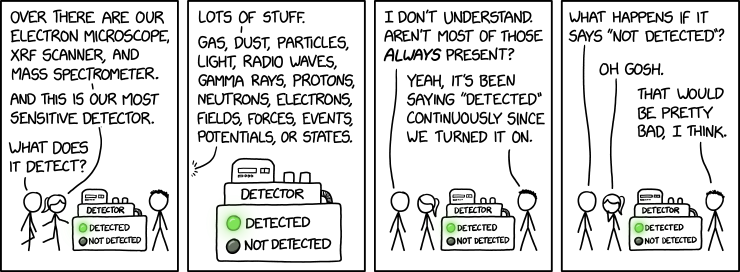
posted by [syndicated profile] xkcd_feed at 05:00am on 06/02/2026
February 5th, 2026

Posted by Athena Scalzi

One of my favorite sakes of all time is Ozeki’s Hana Awaka Sparkling Flower Sake. At a low 7% ABV and a beautifully light slightly sweet bubbly flavor, it is truly a treat to sip on alongside some sushi. Plus, it comes in a super cute 250ml pink labeled bottle. A perfect serving for one person!

A small, pink labeled bottle of sake, with a small shot glass next to it full of the clear, lightly bubbly liquid.

So, this past week, while perusing my local Japanese goods store in the next town over, I looked at their small sake collection and saw Ozeki’s Hana Awaka Sparkling Yuzu sake in the classic 250ml bottle, except this time it was in a yellow label to match the yuzu flavor.

I was honestly really excited to try this flavor since I adore their flower flavor so much, and the yuzu flavor was an even lower alcohol content than the flower so I imagined the flavor being even nicer.

I didn’t really care for this sake! It just tasted too much like lemon Pledge. I was hoping for a light, refreshing, bubbly citrus flavor that wasn’t overwhelming or too artificial, but sadly it was just kind of disappointing and definitely artificial tasting.

It tasted more like a 20% ABV lemon liquor than a 5% sparkling sake. It just was kind of hard to drink, unlike the flower flavor which is very easy, nice sipping. They also have a mixed berry flavor and a peach flavor that I would love to try, but haven’t seen anywhere before. Interestingly enough, the place that I first tried the flower flavor was at Sky Asian at their 9-year anniversary lunch.

Sadly, the yuzu flavor was just not up to par, and I will probably not re-buy it. If I see either of the other two flavors, I will be sure to check them out and let y’all know my thoughts!

Have you tried Ozeki sake before? According to their website, they have plenty of other types of sake besides their sparkling ones. I’d love to try some of their Junmai Daiginjo. How do you feel about sparkling sake? Let me know in the comments, and have a great day!

-AMS

posted by [syndicated profile] scalziwhatever_feed at 07:06pm on 05/02/2026

Posted by Athena Scalzi

A good beside manner makes all the difference in your medical care. So how polite could a robot doctor or AI nurse be? Justin C. Key makes the argument that human connection in medicine is an absolute requirement, and empathy should be all the rage amongst hospital staff. He took this attitude into the creation of his newest novel, The Hospital at the End of the World. Grab you insurance card and come see how connection and community are some of the best medicines.

JUSTIN C. KEY:

It’s hard to keep your humanity in medical training.

It’s a potent thought considering the AI war brewing. We have a process of training doctors that desensitizes, burns-out, and enforces systemic biases. If we’re training people to be robots, why not let the actual robots do it better?

In crafting this book, I set out to make a case for the opposite.

I’m a science fiction author who happened to go to medical school for the same reason I’m drawn to writing: the belief in the inherent value of human connection. I learned early in my medical journey that our healthcare system makes it very difficult to uphold this value. Physicians are overworked, bogged down in red tape, swimming upstream against a for-profit insurance system, and have too many patients and not enough time.

Then there’s the training itself. I didn’t like medical school. I didn’t like the hierarchy. I didn’t like the glorification of battle scars. I didn’t like the environment that pushed my classmate to suicide just months before graduation. Though my alma mater did great work in teaching the art of medicine and the importance of being with your patient, the core culture remained.

It wasn’t until I’d gotten my degree, had some years of autonomous patient care under my belt, and had the chance to process my experiences through my writing that I realized how magical it is to become a healer. No, not in an elitist or ‘holier than thou’ way. But the privilege to build a partnership meant to enhance a human life and, in a lot of cases, save it.

My first novel follows young medical student Pok Morning. There’s the premise you’ll get on the jacket cover and in the pitches and in the interviews—AI vs medicine, who will prevail?!—but as the larger, existential battle rages on, Pok still has to navigate the brutal process of becoming a doctor. How could I strike the balance between my perceived experience and later reflections? I was also asking a deeper, more introspective question: how did I come out of training valuing human connection so much when the process could have very well stripped me of that? 

The importance for humanity in medicine isn’t a given. With delivery and mobile apps, we are more and more disconnected from the people with whom we exchange services. And one can’t deny that there are some tasks a cold, calculated machine might be suited for. Even then, usually the best result comes from a pairing with human intuition. I wouldn’t knowingly get on a plane that didn’t have both an experienced pilot and a functional autopilot computer system. Would you? 

And then there’s the risks of having a human in the driver’s seat. Computers can’t drink and drive. They can’t be distracted by texting. They can’t forget to check a burn victim’s throat for soot just because a cooler case rolled by in the ER (yes, I literally just rewatched THAT Grey’s Anatomy episode). 

And thus winning the war of AI vs medicine is less about showing the flaws of AI (and trust, there are many and if I were an AI I’d make up a fake statistic to prove that point) but rather in making the case for humanity’s value. The most rewarding part of medicine—certainly for me and I suspect a lot of my colleagues who still hold hope—is helping someone by tapping into our own human parts. Empathy. Perspective. Community. This power is separate from outcomes. The task is easiest (and possibly even in AI’s reach) when the treatment worked and the patient improved. But what about when things go wrong? What about delivering bad news? What about being with someone during the hardest part of their life? There’s value in being seen and heard by another human. if a generated likeness said and did everything right, I’d bet that, for the patient, the experience would be as rewarding as watching a robot win the Olympics (in any category).

And yet . . . our healthcare system leaves little space for quality time between physician and patient. Those seeking help are left feeling unheard, underprioritized, and scrambling for alternative solutions. I fear that AI is going to come in and fill in these gaps (ChatGPT therapist, anyone?). Which is a shame because technology is supposed to relieve a physician’s burden and create more time for deeper connection, not eliminate it altogether. That dichotomy fuels the background of this book. Pok learns the ‘hard way’ of doing medicine while discovering its value.

There’s a moment early on in Pok’s medical school career where he doesn’t do as well as he hoped and feels he’s the only one. That everyone else is doing fine while he struggles. It’s a horrible place to be. I know because I’ve been there. But as the author of Pok’s world, I was able to imagine what it would look like to be lifted up from that, to have such disappointment strengthen community, resolve, and humility. The same way no one gets through illness alone, no one becomes a physician in isolation. The experiences that shape do so through the social lens.

Connection begets connection and that’s why it’s essential that medical education doesn’t exist in a bubble. There’s various levels of socialization, from peer to peer (Pok and his classmates), mentee to mentor (Pok and his professors) and, at some point, mentor to mentee (the student becomes the teacher). Like much of life, these interactions can go well or they can be stressful. They can build up or tear down. The types of community one experiences while becoming a physician can very much inform what they will recreate with their own patients. 

The type of medicine I created in The Hospital at the End of the World reflects what I strive to achieve as a physician. How did I put it on the page? By combining the essentials from my own experiences with what I hope will change for future generations of student doctors.  Pok, and hopefully my readers, are better for it.


The Hospital at the End of the World: Amazon|Barnes & Noble|Bookshop|The Rep Club

Author socials: Website|Instagram|TikTok

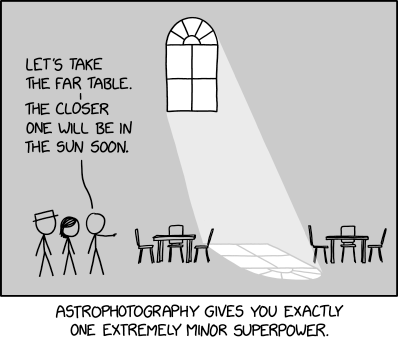
posted by [syndicated profile] xkcd_feed at 05:00am on 04/02/2026
posted by [syndicated profile] scalziwhatever_feed at 01:11am on 05/02/2026

Posted by John Scalzi

Me (peering at the painting on my dentist’s waiting room wall): This painting is new since the last time I was here.

Dentist: Probably.

Me: And done by the star of the Terminator films!

Dentist: What?

Me (points to the signature in the corner of the painting): Linda Hamilton.

Dentist: Dude, shut up.

For the record: Probably indeed not that Linda Hamilton. Probably also not the two Linda Hamiltons I found online who are primarily artists. One of them does “flower art” while the other does more abstract paintings. Her signature doesn’t match this one here. But in my deepest of hearts I will believe that my dentist has a painting of ducks and ponds done by the celebrated actress. Because life is more fun that way.

— JS

February 3rd, 2026
mark: A photo of Mark kneeling on top of the Taal Volcano in the Philippines. It was a long hike. (Default)
posted by [staff profile] mark in [site community profile] dw_maintenance at 10:25pm on 03/02/2026

Hi all!

I'm doing some minor operational work tonight. It should be transparent, but there's always a chance that something goes wrong. The main thing I'm touching is testing a replacement for Apache2 (our web server software) in one area of the site.

Thank you!

Posted by John Scalzi

HOLY FUCKING SHIT I AM IN THE FUCKING EPSTEIN FILESSpecifically, my essay "Straight White Male: The Lowest Difficulty Setting" is referenced in a 2013 Rachel Sklar article about Muriel Siebert. Why is it in the Epstein files at all? You got me. What a wild fucking discovery. I am literally agog.

John Scalzi (@scalzi.com) 2026-02-03T07:06:50.335Z

To be clear, I did not expect to find myself in the Epstein Files, inasmuch as I have neither ever met nor have ever communicated with Jeffrey Epstein, nor do I hang out with the sort of people who find themselves on the private planes or islands of known sexual traffickers of children — a fact I’m deeply relieved about, if you want the truth of it.

Nevertheless when I learned that the database of the files is searchable, I put “Scalzi” in it to see what would pop up. I expected — and thus was not surprised by — several references to that name, because a banker with that last name handled some of Trump’s accounts at Deutsche Bank several years ago (no relation, as far as I know). But one of the references is indeed to me: Writer Rachel Sklar referenced me in an article she wrote in 2013, which is in the files for some reason, I assume because someone forwarded it to someone else in an email.

And, look: If one must have the appalling fortune to be in the Epstein Files, a one-sentence reference to an essay one wrote, located within another essay, neither about a topic that has anything to do with the exploitation of children, is almost certainly the best-case scenario. But it doesn’t mean I didn’t look at the reference when it popped up and say “oh, fuck” to myself. What a wild, unsettling and unhappy context in which to find one’s self.

So why mention it at all? One, because when people inevitably come across that reference to me in the files and email me about it, I can point them to this as a way to say “Yup, seen it, what a weird fucking thing that is” without having to type it out every single time. Two, I have enough detractors out there that one or more of them will loudly proclaim to their little pals that I am in the Epstein Files, and then slide past the actual context of being referred to tangentially, rather than being an actual participant in atrocities. Pointing this out before they do gives me “first mover” advantage, and the ability to point out what my appearance is actually about. This won’t stop some of them from misrepresenting my appearance, but that’s because they’re sad little weenies. Here’s the actual file I’m in. You can see it for yourself.

Nevertheless, a declaration:

For the absolute avoidance of doubt: Never once ever had anything to do with Jeffrey Epstein or any of his band of heinous child rapists up to and including the current president of the United States. Put them all into prison. Every single one of them. Never let them out.

John Scalzi (@scalzi.com) 2026-02-03T07:06:50.336Z

I trust that will make my position on Epstein and his party pals clear enough.

What a strange and unpleasant time we are living through, nor are we out of it. And once again I have cause to marvel at the weirdness of my own life, that I should show up, even as an aside, as part of one of most horrible political scandals in US history. I would have just as soon sat this one out. But since I can’t, at least I can tell you how I got there.

— JS

February 2nd, 2026
mneme: (Default)
posted by [personal profile] mneme at 11:45pm on 02/02/2026
I've been getting some feelers and at least one interview opportunity which seemed to vanish re-appeared, but I'm also widening my net -- it's so easy to try to use only the job sites and particularly LinkedIn, but in fact so many companies only post their jobs on their internal web site so if there are placed you'd love to work I guess it's best to look directly there to see if they have openings.

In other news, the larp (re-run for the first time in 15 years ago! Written 17 years ago! Yeah, there's a lot to unpack here) is coming together; we'll send out the casting hints tomorrow (HOPING) and then do some edits on the character sheets for the next two weeks before things get busy again (with Dreamation and then Intercon in quick succession!).

We went out to NOLA two weeks ago for a friends thing (and to see Chwebaccus) and then our plane got delayed for four days (it was originally going to come back on Sunday). So, we HAD to spend the week in NOLA (oh, no!) for an extra four days, finishing out the week; I can't really complain; it gave us some time to reflect and in which we couldn't keep our existing patterns (and also some extra days to enjoy NOLA nightlife, including a Fusion Dance thing that was apparently their revival of the local scene; I mostly danced with [personal profile] drcpunk but did also get dances with around 4 other dancers which was nice. The venue was in the back of a clothing shop, which gave nice speakeasy vibes (although since it didn't occur to me to buy soda from the store, I got rather parched and we headed out after 2ish hours when the band finished their set).

Before that, we did Arisia, which was small (for an Arisia, anyway) but rather pleasant.

I've also gotten back into reading Wyrm (which I had previously paused after reading chapter 21). I have to prioritize working on the larp, but it's pretty nice.

Posted by Athena Scalzi

A shot of my hand holding one of the individual bars so y'all can see the cross section.

Last week, I was having a serious craving for some fresh baked chocolate chip cookies. Between the weather and the world, I really felt like a cookie would help improve my morale.

So, I decided to try out Half Baked Harvest’s recipe for what she calls “Really Good Chewy Chocolate Chip Cookies.” Let’s get right into the process of making them and how they turned out!

Looking at the ingredients list, it’s pretty clear that these are definitely pretty standard cookies made with just everyday household items. Sugar (white and brown), flour, eggs, butter, some vanilla, chocolate, it’s all the usual suspects. Thankfully I didn’t have to go out and buy anything, I could just get right into baking.

The first thing to do was to brown the butter. I was surprised by this step because usually if browning butter is required in a recipe, the food blogger will include such information in the title of the recipe. Like, if I make Binging With Babish’s brown butter chocolate chunk cookies with flaky sea salt, I make a point to mention allll of that.

Anyways, I browned the butter and let it cool off for just a bit while I mixed together the sugars, eggs, and vanilla. Normally I use a stand mixer, but the recipe says that all you need is a bowl and a whisk, and really don’t need an electric mixer. I decided to follow in the spirit of the recipe and keep things simple. Simple ingredients, simple equipment.

After adding the butter (which was still melted but not hot so I didn’t cook the eggs), it was finally time to add the dry ingredients. The recipe calls for 2 cups of flour, and pretty much the second I put in the two cups, I could tell that it was too much flour.

I know what you’re thinking. You’re thinking I packed the measuring cups too full of flour, resulting in extra unaccounted for flour in the mix. I’ll have you know I am a pro, and I spoon all the flour into the measuring cup, resulting in a nice, loose cup of flour rather than a tightly packed one. So it wasn’t my fault (this time, anyway).

The dough immediately became very dry and crumbly, and wouldn’t hold any type of ball shape. It would crumble apart so easily that the dough wasn’t even retaining any of the chocolate chips, they would just fall out.

I knew there was only one thing to do (besides cry and throw the bowl of cookie dough off a cliff). I was going to have to press all the dough into a 9×13 and make cookie bars.

I wasn’t sure how to adjust the cooking time for that, but I figured the initial temperature of 350 would be okay, so I put them in and basically eyeballed them until they were done, which took less than twenty minutes, I think. Here’s what they looked like:

A baking pan full of freshly sliced chocolate chip cookie bars with flaky sea salt sprinkled on top.

Honestly, they didn’t look too bad! They were pretty okay right out of the oven, but as they cooled they quickly got harder and harder, until eventually all I had was a pan full of chocolate chip bricks. I can only assume it’s from how dry the dough was due to all the flour, but these were definitely more like biscotti. Certainly no “chewy chocolate chip cookie” in sight.

I was definitely a little disappointed, but at least they tasted pretty good and could be slightly softened in the microwave, then washed down with a nice, cold glass of milk.

Do you like cookie bars? Is chocolate chip your favorite type of cookie? Let me know in the comments, and have a great day!

-AMS

posted by [syndicated profile] scalziwhatever_feed at 04:16pm on 02/02/2026

Posted by Athena Scalzi

Author Veronica G. Henry has come up with a library that truly has all the answers, thanks to its ever-evolving AI. Take a tour through The People’s Library in Henry’s Big Idea, and don’t forget to pay your late fees.

VERONICA G. HENRY:

The first time I realized that the past, present, and future can be contained in one essence was when I discovered the library. For in the absence of a more suitable reality, stories can provide a transformative diversion. In quiet moments, when I reflect on seasons of births and deaths and that middle part we call life, I also think of libraries.

I don’t know the when, but I know the where. It was in my hometown of Brooklyn, N.Y. that I first wandered into a library. The details are fuzzy, so I’ll flex a little creative muscle. I was an infant, already curious, definitely precocious. Determined even then to pursue the quest for more. Baby me was swathed tight against the winter cold, nestled protectively in my father’s determined arms. He marched through those painted oak double doors and introduced me to a new world and an obsession that persists to this day.

That’s how I like to remember it, anyway.

Though my career initially steered me towards a decidedly more left-brained path, the love of the written word and fate prevailed. I also became an author, one who alternates drafting my novels between home, the occasional coffee shop and yes, libraries. So it was inevitable that someday, I’d pen a story in the magical setting that planted that literary seed so long ago.

Inspiration struck as it occasionally does for me, in the form of an article. The feature extolled a library in Denmark where you could borrow a person instead of a book. Each had a title: unemployed, refugee, bipolar, etc., and in this mutually beneficial exchange, “readers” learned through conversations that challenge you to confront your own prejudice. Was it true? I didn’t much care. Because there, my friends, was my Big Idea.

The People’s Library was in large part, inspired by that article. If that was the kindling, the technical part of my brain supplied the spark. Though familiar to me, artificial intelligence (AI) was still a relatively new concept for the masses when I began writing. That changed faster than anticipated. Much of what we see today is specialized, task-focused systems that mimic human intelligence. However, its evolution, artificial general intelligence (AGI), is the promise of autonomous learning, thinking, and adapting. Think of AI as a really smart single-focus tool and AGI as analogous to the exponentially more complex functionality of a human mind.

This technology became the backbone of my future library. Only there would be no need to borrow a real person, but instead, an AGI replica of some of history’s most fascinating figures. The virtual personage, or virtus as I call them, were born. There was and still is a part of me that is as intrigued as I am terrified by this idea. I didn’t want to write it. That meant without a shadow of a doubt that I had to write it.

As the core idea solidified, I turned my attention to characters. Was there any doubt that my protagonist would be a librarian? Not for a second. She’d be forced to work in this futuristic library that is in direct opposition to everything she believes in. Echo London, anti-tech synesthete became my curator of The People’s Library. To say that she accepted the role with little grace, is an understatement. I drew inspiration from every librarian I’ve ever met and even Regina Anderson Andrews, the first African American woman to lead a NYPL.

As for the rest of the characters, I had to stop myself from thinking about all the fascinating historical figures I’d welcome the opportunity to chat it up with and focus on those who would best serve the narrative. One of the central questions that Echo wrestles with is human consciousness. What defines it, where it originates, how it exists before it finds its way into a human body. I needed a cast of deep thinkers with specialized skillsets to help her along that journey. So as not to introduce any spoilers, I think it’s best to let you discover the rest of the team organically. They were a ton of fun to research and write.

I’ll close with this food for thought. If you were to visit a future library where you could borrow a living, thinking, seemingly exact replica of a historical figure, would you? And if you did, whose consciousness do you wish you could converse with today?


The People’s Library: Amazon|Barnes & Noble|Bookshop|Powells|Sistah Sci-fi Signed Copy

Author Socials: Website|Bluesky|Instagram

posted by [syndicated profile] xkcd_feed at 05:00am on 02/02/2026
January 31st, 2026

Posted by Athena Scalzi

Though I am a bougie bitch, there’s nothing quite like a mug full of Swiss Miss hot chocolate. I am an especially big fan of their Marshmallow flavor, so you can imagine my shock when I learned about their Marshmallow Lovers flavor that comes with even more dehydrated white chalk block marshmallows.

I’m willing to bet you didn’t even realize there were two different Marshmallow varieties of Swiss Miss to choose from. Aren’t you so glad I taught you something useful?

Anyways, I, as a Marshmallow lover, decided to see which Marshmallow Swiss Miss variety was superior. Were there enough marshmallows in the Marshmallow flavor to sate my love of them, or did I need to purchase the Marshmallow Lovers box?

Using a digital scale and some math (not easy for me), I have come up with some numbers for your consideration.

So, if you went to Kroger right now and were wanting to buy just a regular, standard size pack of hot chocolate, you’d have your choice between an 8-pack of the Marshmallow Swiss Miss, and a 6-pack of the Marshmallow Lovers Swiss Miss. Both are currently listed as selling for $2.99. I’m sure you’re wondering, well why does the lovers pack have two fewer envelopes than the regular Marshmallow pack? It’s actually because each hot chocolate packet in the Marshmallow Lovers box comes attached to a separate packet that contains the marshmallows, whereas the regular Marshmallow packs have the marshmallows in the hot chocolate envelope rather than being a separate entity.

Anyways, I decided to rip each of one open and weigh them out.

I went with the Marshmallow Lovers packet first. After zeroing out a bowl on a digital scale, I dumped only the contents of the hot chocolate packet into the bowl. The powder came out to 40 grams. I then threw in the marshmallows. The total weight was now 45 grams. A whopping 5 grams of marshmallows in the Marshmallow Lovers packet.

I zeroed out a new bowl so there was no residual powder to contribute to the weight of the Marshmallow packet. I dumped it in the new bowl, then carefully removed each marshmallow from the powder so I could weigh the powder alone first. 38 grams of powder. I threw the marshmallows back in. 39 grams.

I could hardly believe my eyes. A measly one gram of marshmallows in the Marshmallow pack? It felt like too little, but if you go for the upgrade of the Marshmallow Lovers, you lose out a whole two envelopes!

If you add it all up, in the entire Marshmallow box, there is 304 grams of hot chocolate, and 8 grams of marshmallows. For the Marshmallow Lovers, we’re looking at 240 grams of hot chocolate, and 30 grams of marshmallows. 25% less powder, but almost 4 times the amount of marshmallows. Is it worth it to buy the Marshmallow Lovers package? It’s tough to say.

Part of me is tempted to buy the Marshmallow Lovers package just so Swiss Miss knows there’s someone out there that loves their marshmallows. They have to see demand if I want them to keep making it, right?

On the other hand, I could just buy regular Swiss Miss and put my own marshmallows in it. I don’t need Swiss Miss to supply me with their little freaky mallows, I can just throw mini Jet-Puffed marshies in any cup of hot chocolate I want, and as many as I want. I am not limited to a mere one or even five grams.

For now, I will drink the Marshmallow one, because the 30-pack of it was selling for a really good price, so it just made sense to get the bulk box. I will absolutely go through it all.

Do you like hot chocolate? What do you like to top yours with? Have you tried the Marshmallow Lovers variety yourself? Let me know in the comments, and have a great day!

-AMS

January 30th, 2026

Posted by John Scalzi

Yesterday evening, I and author, political candidate and former NFL player Chris Kluwe got together at Ann Arbor’s Downtown Library to talk about books, libraries, politics and the general state of the world, among other topics. And they recorded it! And put it on the Internet! And you can see it above. The conversation starts at about the 8:50 minute mark and runs about an hour, including audience Q&A. Enjoy.

posted by [syndicated profile] xkcd_feed at 05:00am on 30/01/2026
January 29th, 2026
posted by [syndicated profile] scalziwhatever_feed at 10:00pm on 29/01/2026

Posted by Athena Scalzi

Hey, everyone! I just wanted to take a moment to thank a reader who sent me some very lovely spices from Penzey’s. It really made my day to open a package I wasn’t expecting and get something so awesome!

Two variety boxes of Penzey's spices, each containing eight glass spice jars. Plus one free sample packet!

So many commenters have recommended this spice brand to me, so I’m stoked to try it out finally. Also, I didn’t realize they were glass jars until I actually touched them. The fact that they’re glass just makes them so much better, honestly, like how aesthetic and nice is that?

Gift giving is my love language, so it really means so much to me that someone thought of me enough to send such a kind gift. A truly perfect housewarming gift!

I won’t name them in the post, in case they don’t want the attention, but if it was you please feel free to claim your glory in the comments, you rock!

Can’t wait to whip something up with these spices, especially the more unique ones.

-AMS

posted by [syndicated profile] scalziwhatever_feed at 05:56pm on 29/01/2026

Posted by Athena Scalzi

Author Miles Cameron is here today to introduce you to book number one of his space opera series. Though the first of many to come, there’s plenty of spaceships, drama, and war to go around, so strap in for the Big Idea of Artifact Space.

MILES CAMERON:
In 2018, I was sitting at a small SFF con in London with Alistair Reynolds, one of my favourite all-time Science Fiction authors, and I confess I was being a bit of a fan boy, telling him all about what I loved in his books, and he waited me out and then said something to the effect of ‘I hear you spent time on an aircraft carrier.’ The two of us then chatted away for half an hour about life on a carrier and how much we both thought it might be the closest thing to life on a big spaceship, when my editor (up until then I mostly wrote historical fiction and fantasy) turned around in her seat and said, ‘I’d buy that.’
When you are an author, these are very important words. I marked them down. I began to consider how I’d write a science fiction novel loosely based on ‘life on an aircraft carrier.’ Still, despite my military service, I wasn’t really interested in writing ‘military sci-fi’ per se, and I wrote myself some notes and—did other things.
A year later, I was writing a series of historical novels based in fifteenth century Venice and I became fascinated by the idea that Venice—a maritime state—built enormous (for 1450) galleys that carried on most of the trade with the Islamic world, travelling for months and even years on pre-determined routes that linked far-off lands like England and Egypt. I loved the idea that these Venetian seamen would, in the same trip, see so many disparate societies.
These ships doubled, in time of war, as major fleet elements. The idea of combined trade and military fascinated me, and Venice fascinates me still, and there it was—Great Galleys, like spaceborn aircraft carries, on long trade missions to the stars. I mean, there it was, except that it lacked a story.
I have a belief that art makes art; some of my best ideas have come to me while watching a good live play, an opera, a ballet, or a movie. I’m not sure exactly why; there’s an element fo free-association to watching people perform, I suppose—but it always works for me, and in the case of Artifact Space I was watching Florence Pugh in ‘Little Women,’ the last time I went out before COVID and lockdown here in Toronto. I sat there, watching this wonderful performance of one of my favourite books from childhood, and suddenly it was all there. I knew how I would design the human sphere to reflect Venetian trade routes; I saw how I could have the book start in a futuristic Saint Mark’s Square (the heart of Medieval Venice) and I suddenly saw my protagonist and the arc of her story. I think one of the problems of my first ‘Big Idea’ was that the aircraft carrier wasn’t a story—it was an idea. Venice in space was an idea. Both were backdrops on the way to world building. I have the good fortune to be a second-generation author, and one of my father’s favourite sayings was ‘an idea is not a book.’ True words. The aircraft carrier was not a book. Even the idea of Venice in space was not a book.
But Marca Nbaro is a protagonist with a back story and a future arc, and putting her, via Florence Pugh playing Amy March, aboard a ten-kilometre spaceship trading with aliens—it all came in a second. I knew Marca, I knew where she was going and I knew the set of secrets at the heart of the series that would drive the action. I could see the events–alien contact, Artificial Intelligence and its possible flaws, and the difficulties of a trade empire suddenly forced to act as a polity in the face of threat and change.
Good stuff. Other writers have been there before; I’m a huge fan of C.J. Cherryh and she won a Hugo writing on similar themes in Downbelow Station, one of my favourite books of all time. But I had one more ‘Big Idea’ to toss into the mix, because politics interests me and we live, right now, in ‘Interesting Times.’ I wanted humanity to be trapped in someone else’s war, bit players in a larger play, forced to make society-altering decisions just to survive. I wanted to show change, the sort of change people my age have already seen sweeping over us; technological change, societal change, political change.
Interstellar trade, giant spaceships with thousands of crew, massive political change, Alien contact, and one somewhat battered orphan trying to find her place in the universe. Sitting in the theater as the lights came up, it was, I promise you, all one Big Idea.


Artifact Space: Amazon|Barnes & Noble|Bookshop|Powell’s

Author socials: Website|Bluesky|Instagram

January 28th, 2026

Posted by John Scalzi

When the history of the moment is said and done, there are going to be people who wished they had been on the same side as Bruce Springsteen and Billy Bragg, and some who will lie that they had always been. But they will know the truth, and so will others. It won’t be forgotten.

— JS

posted by [syndicated profile] xkcd_feed at 05:00am on 28/01/2026
posted by [syndicated profile] scalziwhatever_feed at 04:05pm on 28/01/2026

Posted by Athena Scalzi

When you have two great ideas, why not have them work together to get the best of both worlds in one story? Author Salinee Goldenberg decided to do just that for her new novel, Way of the Walker. Enjoy hearing about her process of combining these ideas in her Big Idea.

SALINEE GOLDENBERG:

‘In its bare reality, decolonization reeks of red-hot cannonballs and bloody knives. For the last can be the first only after a murderous and decisive confrontation between the two protagonists. This determination to have the last move up to the front, to have them clamber up (too quickly, say some) the famous echelons of an organized society, can only succeed by resorting to every means, including, of course, violence.’

-Franz Fanon, The Wretched of The Earth 1961

There were two ravenous wolves of ideas within me when I sat down to write Way of the Walker. In one corner, we have an anti-colonialist war epic inspired by the late Rattanakosin era of Siam and the surrounding conquest of Southeast Asia by western powers. In the other, a character study, an anti-hero saga starring our headstrong protagonist Isaree, an estranged phi hunter on a journey of self discovery, defined by her uncompromising morals and a mission to administer the justice she sees absent in the world.

These two Big Ideas circled the story, which at times, frantically evaded capture, a juicy, nimble deer that refused to be devoured completely by one or the other. I needed to force my two hungry wolves to politely share this meal — to collaborate on its consumption in a viably publishable amount of words. Even though Way of the Walker is a stand alone, the real life inspiration behind the world of Suyoram began with my first novel, The Last Phi Hunter, a dark fantasy adventure inspired by Thai culture, folklore, Buddhism, and mythology. I didn’t want just a snapshot into a fantastical world, I wanted it to feel alive. A living world breathes, grows, dies, evolves… so I explored the effects of modernization in rural lands, the nostalgia of fading traditions, the death of mysticism, the yearning for a life that never was. I dipped my toe into the historical inspirations behind the world of Suyoram, but for the heavy themes in Way of the Walker, there was no shallow end to wade into. I had to dive in headfirst. 

Something that deeply interested me has always been how Thailand avoided colonization throughout the centuries as competing European powers descended upon the resource rich region and violently established control. Fortuitously, Siam’s geographical location served as a buffer between the British Empire and French Indochina, but Monkut and his heir Chulalongkorn (King Rama IV and V, respectively) realized that subjugation would be inevitable without drastic action.  

They educated their nobility overseas, adapted western fashions and architecture, and passed democratic legal and social practices, to the extent that some historians contend that Siam “colonized itself” in order to be perceived as culturally equal by the encroaching imperialists. Through territorial concessions, policy reforms, and diplomatic ingenuity, Siam remained independent, and the name of the country was eventually changed to Thailand in 1939 — “Thai” literally translating to “free.”

However inspiring this was, I wasn’t interested in writing a court intrigue dense with complicated political discussions. I wanted action, magic, murder, romance, mayhem! So the historical set up was only a jumping off point for the second wolf to come in. The “Grisland” antagonists in Way of the Walker are a conglomeration of western-coded oppressors, and I pulled more inspiration from struggles for sovereignty not only from other Southeast Asian countries like Vietnam and Malaysia, but from all around the world —  Algeria, Cuba, Bolivia, Kenya, Palestine, and more — no colonized peoples are ever alone.

Revolutions arise from the oppressed, the working class, the people, which the protagonists from both books are — but Ex from The Last Phi Hunter wasn’t the right lead for this story. His daughter Isaree, however, has grown up in the shadow of atmospheric violence, and was the natural evolution for this point of history. The injustices she witnesses and a crisis of faith drive her to seek answers, to seek power, and ultimately, to strike back at the oppressors, despite the personal cost. She’s heroic, but flawed, and not without limitations. 

The worst of these limitations was a narratively practical one. Isaree is a viciously fun character to write, but she’s all predator, instinct and raw power, with one foot into the world of devas and spirits, but can’t tell a treaty from a roll of toilet paper. How do I dig into the meat of a decolonialist narrative if the protagonist has no framework for geopolitics, or international trade wars, or, well… that’s where the Big Idea splits into a secondary POV — the renegade prince sent to kill her, as a favor to appease the king’s allies. With this insider view, we see what Frantz Fanon calls the “colonist bourgeoisie” perspective, which was the mediator bridge I needed, and made for great drama.

I had big ideas for this novel, but it’s something I’ve wanted to explore for years, and I was hungry for it. When I made the last edits, and the pass pages went to print, I can honestly say my appetite was satiated, and I settled in for a two-day victory nap. So if you’re itching for an action-packed fantasy war epic with an angry yet hopeful bichaotic protagonist, and big contemplations of what it means to punch up with a fist full of magic and a heart full of rage, go check it out.


Way of the Walker: Amazon|Barnes & Noble|Books-A-Million|Bookshop|Powell’s

Author socials: Website|Instagram

January 27th, 2026
posted by [syndicated profile] scalziwhatever_feed at 09:00pm on 27/01/2026

Posted by Athena Scalzi

I ordered some Valentine’s themed goods from Michael’s recently, including these heart print champagne flutes. I ordered these because they’re actually made of glass and all other V-Day themed “glasses” I found were actually acrylic, and also way too expensive for plastic fucking cups. How are you going to charge almost ten dollars per “glass” when they’re plastic? Yet these actual glasses were four dollars. Wild.

Anyways, lucky me, two of them arrived shattered:

Two completely shattered champagne flutes sitting on a granite countertop.

(Ignore the multiple packs of Liquid Death in the background, I was trying to fit the cans in the fridge. And YES I like Liquid Death, I don’t care if it’s kind of cringe marketing.)

If you follow my dad on Bluesky or Instagram, you might have seen not too long ago he posted that three of the four (much nicer) champagne glasses he ordered arrived completely broken:

Thankfully, he was able to get a refund, but it was genuinely a hassle. My refund for my two much cheaper glasses was a lot easier, and now a whopping seven dollars is back in my bank account.

Look, this post isn’t about getting refunds or being disappointed by broken glasses, it’s about the fact that somebody needs to start a delivery company that specializes in fragile packages and doesn’t just fastball your package at your front door. You can put “fragile” stickers on a package all you want and that mail carrier is still going to treat it like how airline workers treat your three hundred dollar suitcase. Aka NOT GOOD.

I’m serious, if there were a delivery company that guaranteed careful handling and extra care to get your goods to you in one piece, I’d be thrilled. I’m gonna start needing white glove delivery on every single package at this rate because I’m tired of hearing my package sound like a maraca when I bring it inside.

So, there you have it. My minor annoyance of the day. I shall live.

-AMS

posted by [syndicated profile] scalziwhatever_feed at 05:10pm on 27/01/2026

Posted by Athena Scalzi

We’re all just trying to be good people, and sometimes in that journey we make mistakes. Perhaps the same goes for ghosts, as author A. C. Wise suggests in the Big Idea for her newest novel, Ballad of the Bone Road. Fae queens, paranormal detectives, and famous Hollywood ghosts, oh my!

A. C. WISE:

The big idea behind The Ballad of the Bone Road started out as several small ideas. The names Brix and Bellefeather made their way into my head and struck me as the perfect names for a pair of supernatural investigators. Around the same time, the line “When I was twelve years old, I met the Devil in an oak tree,” popped into my head. Finally, misheard song lyrics put the image in my mind of two young lovers in a hotel room summoning a ghost and becoming a throuple. 

Those three bits of inspiration may not have happened in that exact order, but they happened close enough to each other that it seemed reasonable to me that they would all be part of the same story. The big idea then became a question – how do these pieces fit together? How do I get all these people in the same place and how best to complicate their lives?

While the original line about meeting the Devil in an oak tree didn’t survive fully intact, I realized it was a fundamental part of Bellefeather’s backstory and why she makes the choices she does throughout the novel. Brix, then, would obviously meet the lovers and get caught up in their haunting, which turns out to be far more complicated than any of them could have anticipated.

My previous two novels, Wendy, Darling and Hooked, are a duology of sorts, inspired by Peter Pan. I wanted Ballad of the Bone Road to be something different, but there are certain themes that carry across all three works, namely characters making bad choices in response to trauma. At their core, the characters in all three novels (with the possible exception of James aka Captain Hook) are mostly trying to be good people and do the right thing, but they make a fair number of missteps along the way. They hurt those around them by holding on too tight or by pushing them away; they let fear drive them until it forces their hands and they discover they know how to be brave.

Ballad of the Bone Road is inspired, to a certain degree, by the glamor of the silver screen, an art deco aesthetic, and stories of the fae that depict them as inhumanly lovely and dangerous in equal measures. There are also ghosts, of course there are ghosts, but what happens when a haunting is accidental and more melancholy than malicious? Instead of driving out their ghosts, what if those experiencing the haunting were doing everything they could to hold on?

Even if the initial ideas may have been small and disparate ones, they all came together in the end, and I’m pleased with the questions the book poses and the ways the characters respond to the situations they find themselves facing. They are flawed and imperfect and human – even when they’re not exactly human – and most of them are just trying to do the best they can.


Ballad of the Bone Road: Amazon|Barnes & Noble|Bookshop|Forbidden Planet|Waterstones

Author socials: Website

January 26th, 2026
posted by [syndicated profile] xkcd_feed at 05:00am on 26/01/2026

Posted by Athena Scalzi

So often I write about extravagant, expensive dinners and specialty dining events, but today I’m here to tell you of an absolutely banging bargain lunch.

I love Indian food, but it’s scarce to come by in my area. The closest establishment to me is Amar India Restaurant, and it’s actually its north location in Vandalia rather than its original location in Centerville, which is considerably further south from me.

Amar India North has a lunch menu that starts out at a mere ten dollars, and only goes up to about fifteen dollars if you get one of the more expensive dishes like the lamb curry. There’s also chicken curry, chicken tikka masala, I think a fish curry, and the one I always get, saag paneer.

Once you pick your main, it comes with rice, naan, their vegetable of the day, and a small dessert. This is what the saag paneer platter looks like:

A stainless steel platter with different sections, one filled with rice and the naan on the side, one containing the dessert, one holding the vegetable of the day, and of course a section holding the saag paneer.

Two pieces of plain naan, rice, a big ol’ portion of saag paneer, pointed gourd as the vegetable of the day, and two jalebi for the dessert. I have had this platter three times and each time the vegetable has been different, but never the dessert, which is a shame because I’d love to try some of their other desserts, especially the kulfi and Gulab jamun.

It may not look like much saag paneer but I can assure you it’s a generous portion size for the price. I’m pretty sure the saag paneer platter in particular is thirteen dollars, plus I always get a mango lassi, which is $4.50, so in total I’m spending less than twenty dollars for a very filling and very delicious lunch! I truly think this is such a good deal and you get to support a local business.

I know the Centerville location used to have a lunch buffet. I don’t know if they still do but I’d like to make it down there sometime soon to see for myself. There’s also a Beavercreek location under the name Jeet India Restaurant, so I’ll have to check that out next time I’m in the area.

I just had this meal on Friday but now I’m already craving it again after telling y’all about it. Especially the mango lassi, I really could drink a gallon of that stuff.

Oh, and while you’re at Amar North, they just opened an Indian grocery store right next to the restaurant called Anand Indian Grocery. I popped in there on my latest visit to the restaurant and they have a huge selection of items, including specialty produce and cooking ingredients like ghee and tons of spices, plus the biggest bags of rice you’ve ever seen.

They also have tons of fun and unique snacks and sweets, and even ice cream flavors I’ve never heard of.

If you’re in the Dayton area, I highly recommend making it out to Amar North for their lunch special sometime this week. It’s between the hours of 11am and 2pm. I think I’ll go again tomorrow for a nice solo lunch.

Do you recommend any lunch specials in the Dayton area? Are you also a big saag paneer fan? Let me know in the comments, and have a great day!

-AMS

posted by [syndicated profile] scalziwhatever_feed at 09:47pm on 26/01/2026

Posted by John Scalzi

I was away this weekend visiting a friend and seeing a concert, and my return home was delayed a day because of the weekend snowstorm. Heading back, I managed to avoid the crash on the I-70 that closed all the eastbound lanes of the interstate, but as you see, that luck came at a price: Immediately upon returning home my boots de-soled. The travel gods, apparently, needed a sacrifice.

These boots, as it happens, are nearly twenty years old, so the sacrifice was reasonable. It wasn’t like I had just gotten these shoes. In fact, the fact they were twenty years old was probably why they became a sacrifice; after two decades, the glue had clearly desiccated into nothingness. I can’t complain. I got good value out of these boots. The travel gods may take them to Shoehalla with my blessing.

In other news, I need new boots; there’s a ton of snow on the ground and my Sketchers are not gonna handle that. A-shoppin’ I will go.

— JS

January 25th, 2026
posted by [syndicated profile] scalziwhatever_feed at 03:02am on 25/01/2026

Posted by John Scalzi

I’m away and mostly offline this weekend but I’m seeing the news. Minnesota, you deserve so much better than what this government is doing to you.

— JS

Links

January

SunMonTueWedThuFriSat
1
 
2
 
3
 
4
 
5
 
6
 
7
 
8
 
9
 
10
 
11
 
12
 
13
 
14
 
15
 
16
 
17 18
 
19
 
20
 
21
 
22
 
23
 
24
 
25
 
26
 
27
 
28
 
29
 
30
 
31